A UX feature designed for Co-Flo Enterprise - reframing AI-assisted data validation as a human-centred governance workflow, embedded within the iManage platform.

Co-Flo Enterprise is a software company that helps organisations manage and streamline their day-to-day operations. Their platform is designed to simplify complex workflows, improve visibility across teams, and reduce the manual effort involved in managing work. By bringing together processes, data, and people in one place, Co-Flo enables businesses to work more efficiently, make better-informed decisions, and focus on delivering value to their clients and teams.
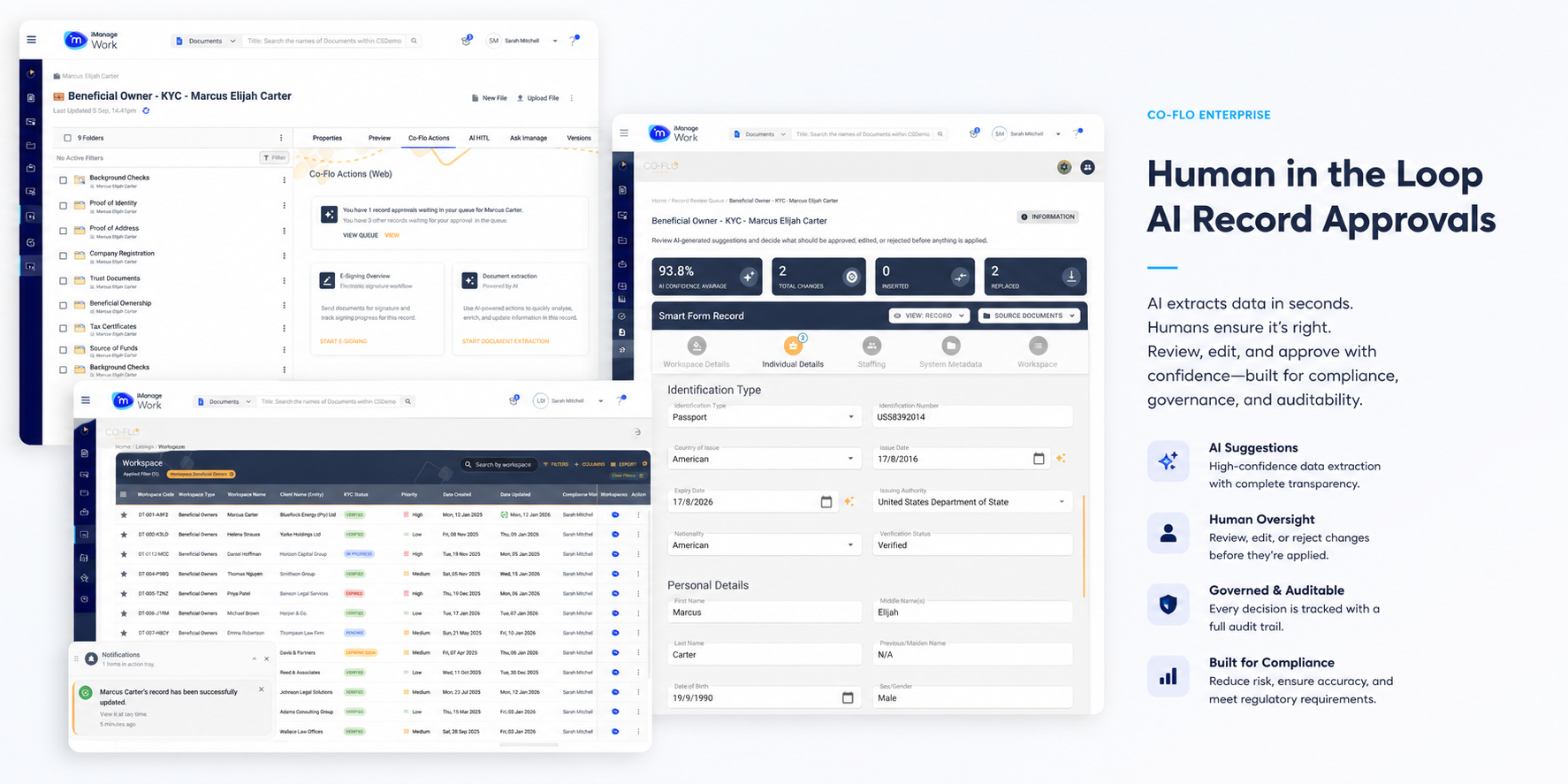
Co-Flo Enterprise uses AI to extract and populate data from legal and compliance documentation but before any record is updated, a human needs to validate it. The original framing called this "AI Human-in-the-Loop," which created a problem bigger than the screen design itself: it positioned the feature as an AI-specific pattern, making every non-AI review flow feel like a workaround.
The real challenge wasn't building a review screen. It was recognising that the underlying need validation, oversight, controlled record updates, accountability is a workflow governance pattern, not an AI one. Keeping "AI HITL" as the mental model would mean duplicating review UI endlessly across AI outputs, manual updates, manager approvals, compliance signoffs, and external partner verification. That's not scalable, and it's not honest to how users actually think.`
Enterprise users in legal and financial services - compliance officers, administrators, and managers working within iManage-based platforms who are responsible for the accuracy and integrity of records.
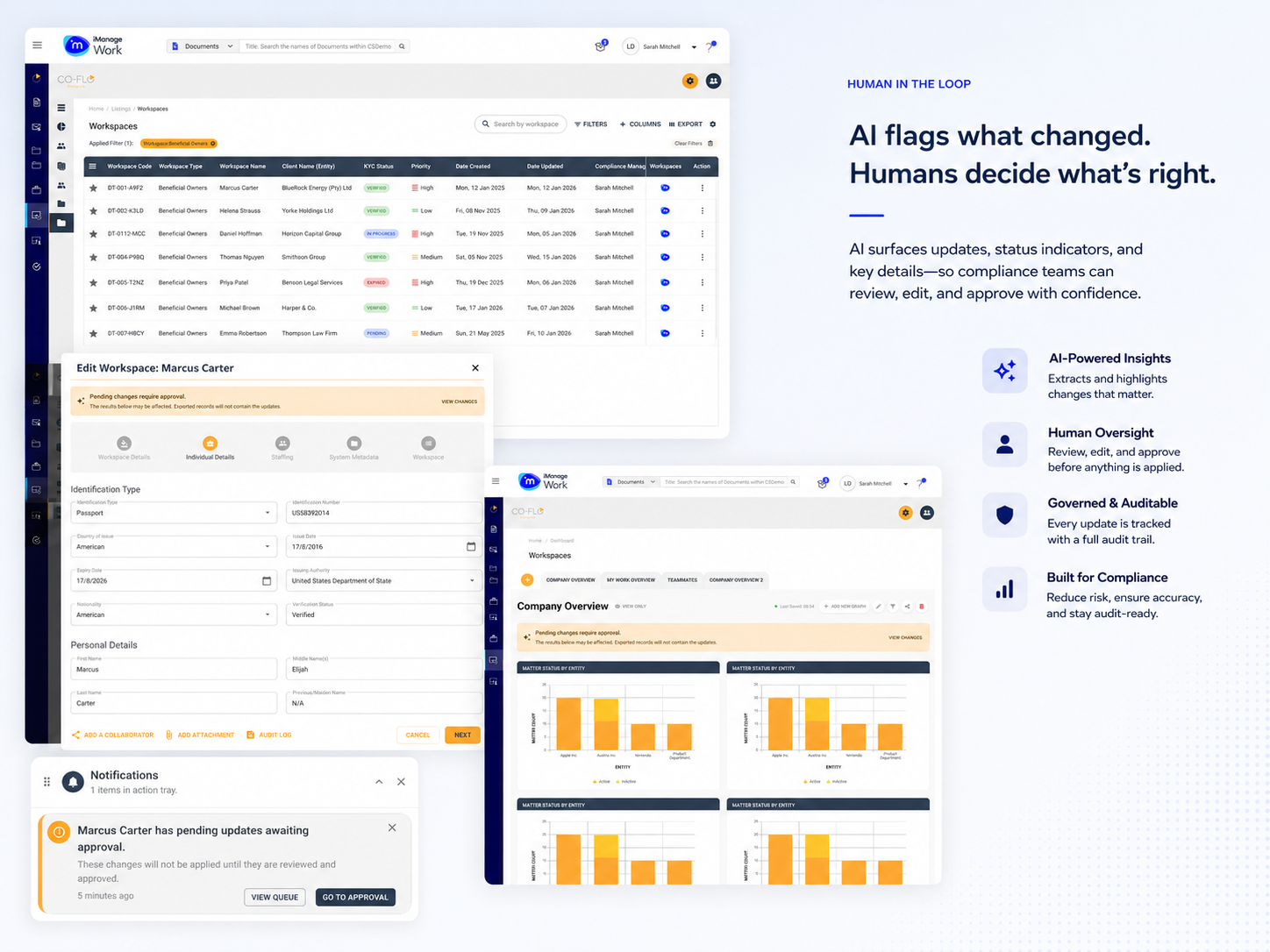
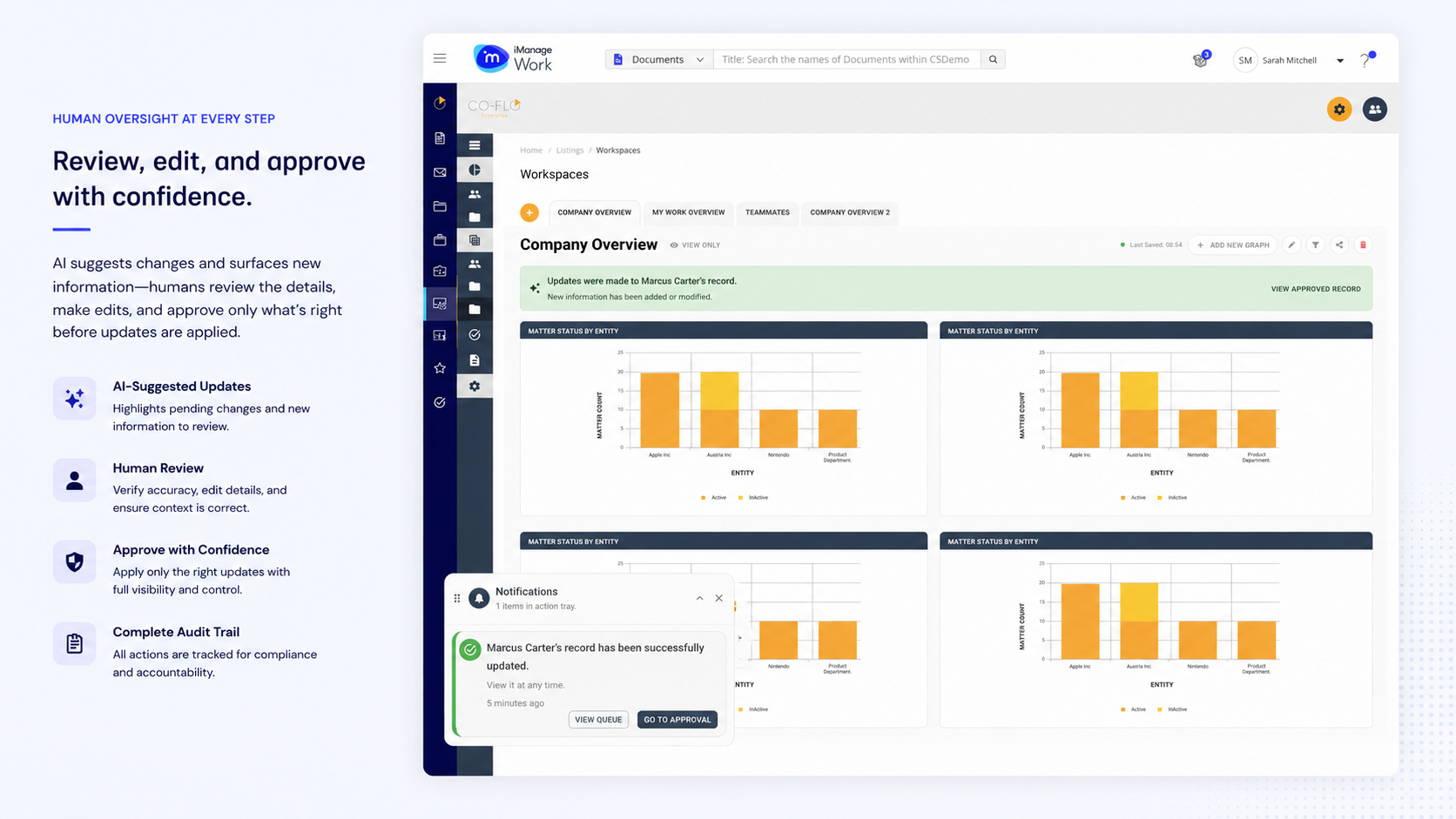
I started with research, understanding the users who would live inside this workflow daily: compliance officers, legal professionals, and enterprise administrators operating in high-stakes, regulated environments where a wrong record update carries real consequences.
From there I developed a persona to ground the team's decision-making, then moved into wireframes and end-to-end UX flows covering multiple user journeys and edge cases. The flow file mapped out over ten distinct sections from initial AI extraction through review, rejection, escalation, and final approval states.
A significant part of the process was strategic reframing. I produced a naming rationale that made the case for renaming "AI HITL" to "Record Review" arguing that a unified review and approval framework would reduce cognitive load for users, enable platform scalability, and future-proof the feature against growing AI fatigue in legal and financial services contexts.
After wireframes, I ran usability testing, analysed the findings, and iterated on the designs before moving into high-fidelity UI. The product was designed to sit natively within the iManage desktop environment.`
In legal, compliance, and financial services - the iManage world - a wrong record has downstream consequences. A name misspelled, a date misread, a figure incorrectly extracted from a document - that error doesn't stay on one screen. It propagates into contracts, filings, client records, audit trails. The cost of fixing it later is exponentially higher than catching it now.
The AI extraction is fast and largely accurate — but "largely" isn't good enough in regulated environments. Users aren't distrusting the AI, they're doing their job. Oversight isn't optional for them, it's a professional and often legal obligation.
So the value this step delivers is:
The full design encompassing research, flows, tested wireframes, and production-ready UI was completed and handed over. Due to resourcing constraints, only a POC (proof of concept) was developed rather than the full iteration. The design work remains a comprehensive reference for future build phases, and the strategic naming rationale informed the product team's thinking on platform architecture going forward.
When working at Co-Flo, I got an amazing opportunity to work a great cross collaboration team called 'Mystery Inc'
Senior Product Manager · Technical Lead · QA Engineer · 3× Frontend Engineers
